Wood cladding has never been so prevalent in contemporary architecture. Sleek detached houses, bold extensions, apartment blocks with clean lines, striking public buildings: everywhere, wood adorns façades with an elegance that few other materials can match. But what exactly do we mean by modern wood cladding? What trends will define façades in 2025? Which profiles, finishes and visual styles should you choose for a truly contemporary result?
At Sivalbp, we have been supporting architects, builders and private clients for over 15 years. Here is our analysis of the major trends in modern timber cladding, with inspiration drawn from our projects and collections.
Summary
- What is "modern" timber cladding?
- The 5 major trends in modern timber cladding in 2026
- Modern timber cladding and materials: combinations that make all the difference
- What type of timber cladding should you choose for a modern house?
- Is black timber cladding durable?
- Horizontal or vertical timber cladding for a modern façade style?
- Does wooden cladding require a lot of maintenance on a modern façade?

Thermo Nordic Pine wood cladding / Linéa / Café 111 - Credits: Lumipod - Builder: Lumicene - Photographer: Kevin Dolmaire
What is "modern" timber cladding?
The concept of modernity in architecture is not a matter of fashion; it is a deliberate choice. A modern timber cladding is a façade that embraces its aesthetic choices: a bold, dark colour, an interplay of geometric lines, a textured finish, or, conversely, a sense of total simplicity that allows the raw material to speak for itself. It is not the wood itself that is modern or traditional — it is the way it is used.
In practical terms, contemporary projects that use timber cladding share several common features:
- Clean, horizontal or vertical lines, without embellishment
- Bold colours: black, anthracite grey, burnt brown, white or confident natural tones
- A dialogue with other materials: raw concrete, zinc, glass, light-coloured render
- Consistency between interior and exterior: wood is no longer an isolated cladding material; it forms part of an overall architectural design
The 5 major trends in modern timber cladding in 2026
Black and charred wood cladding: a bold statement
This is undoubtedly the strongest trend of recent years. Dark wood cladding – in deep black, charred brown and rich anthracite – has established itself as the signature choice for the most striking contemporary architecture.
Inspired by Shou Sugi Ban (an ancient Japanese wood-burning technique), the burnt wood finish offers unrivalled visual depth. The charred surface reveals the texture of the grain, creates plays of light and shadow in low-angle light, and ages with a nobility that few other finishes can match.
Our Vintage collection from Sivalbp masterfully captures this aesthetic: cladding in Thermo-treated Northern Pine with a deep black Café 11 finish for a uniform and durable burnt wood effect, made in France.
💡 Design tip: Black timber cladding pairs particularly well with a light-coloured concrete plinth or anthracite grey aluminium joinery. The combination creates a mineral-organic contrast that is highly sought-after in contemporary architecture. Black timber cladding also pairs very well with a warmer wood tone for a very contemporary look, as demonstrated by this detached house project.
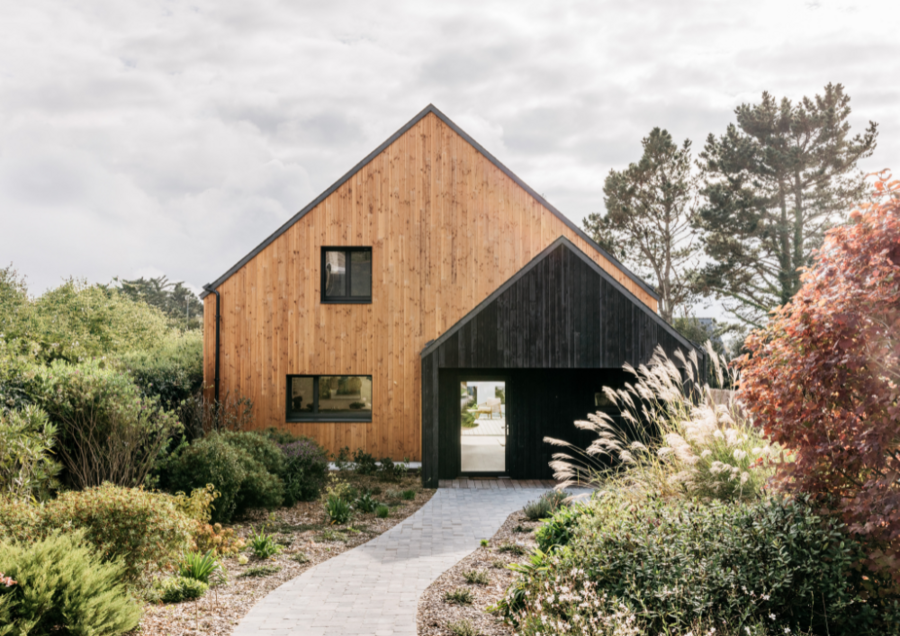
Douglas fir & Thermo Nordic pine cladding / Linéa / Malt 112 & Café 111 - Credits: Detached house (56) - Architect: Atelier K Architecture - Builder: Sign&Bois Construction - Photographer: Yann Audic
Grey and pre-weathered timber cladding: a refined, controlled patina
The natural greying of wood has long been misunderstood; all too often perceived as a sign of deterioration. Today, it is celebrated as a finish in its own right – a soothing, mineral-like patina that blends discreetly into both urban and rural landscapes.
Pre-greyed timber cladding meets a simple need: to achieve a uniform, controlled grey appearance straight from installation, without waiting for the vagaries of natural ageing. It is a way of achieving the final look immediately, with a guarantee of uniformity across the entire façade.
Sivalbp’s New Age collection was designed for this purpose: cladding in Cedar, Douglas Fir, Thermo-treated Northern Pine, Spruce, or Larch, treated with water-based pre-greyed saturators, for an authentic finish and enhanced protection.
Colours such as Grey 102 or Iridescent 108 perfectly illustrate this trend: warm, slightly pearlescent greys that lend an elegant depth to the façade.
💡 Design tip: Pre-weathered timber cladding pairs particularly well with aluminium cladding.

Douglas fir wood cladding / Soléa 2 / Gris 102 - Credits: Detached house (44) - Builder: My Lovely Nature
Vertical timber cladding: a façade that reaches for the sky
Vertical cladding is one of the most distinctive stylistic features of contemporary architecture. Whereas horizontal cladding creates a horizontal spread that anchors the building to the ground, verticality energises the façade, emphasises its height and lends elegance to the structure.
It adapts to all profiles: vertical joint covers create regular, graphic patterns with a strong architectural feel. Vertical slats play with transparency and cast shadows as the sun moves across the sky. False slats give the impression of slats whilst maintaining maximum weatherproofing.
The current trend often involves combining installation directions on a single façade: vertical cladding on the gables, horizontal on the main body — or the reverse. This duality creates a strong, immediately recognisable façade composition.

Douglas fir wood cladding / Tabacoa 2 / Gris 102 - Credits: Detached house (29) - Architect: Atelier INOUT Architectures
Open-joint timber cladding: a façade that breathes
Open-joint cladding has become one of the signature features of contemporary timber architecture. Its spaced-out boards create a dynamic interplay of light and shadow that transforms the façade depending on the time of day and the season. The result is vibrant, ever-changing, and impossible to replicate with an inert material.
From a technical perspective, the openwork design ensures optimal ventilation of the façade, which contributes to the cladding’s longevity and the building’s thermal performance. It is ideally suited for use as a trellis, a roof overhang, a clad pergola or as cladding for secondary structures.
In contemporary architecture, the openwork cladding is often found on buildings that play with the double-skin concept: a dark volume in the background, an openwork cladding of natural or burnt wood in the foreground, which filters the view and the light.

Douglas fir wood cladding / Trapézo / Gris 102 - Credits: Le Clos des Olviers - Architect: BAU Architectes - Installer: Charpente Tradition - Photographer: René Limbourg
Natural, untreated timber cladding: authenticity as a key focus
In contrast to highly polished finishes, another strong trend is emerging: that of wood left in its natural, untreated state, without any surface treatment. It is Sivalbp’s Authentic collection that best embodies this approach: cladding in Red Cedar, heat-treated pine, Douglas fir or larch, supplied unfinished, for an immediate sense of genuine material.
This choice reflects a quest for radical authenticity in architecture. The façade does not hide its material; it showcases it. The wood will naturally weather, take on the patina of time, and blend ever more seamlessly into the landscape as the years go by.
It is also the choice of projects that seek to become part of their natural environment rather than stand apart from it: forest homes, mountain chalets, eco-tourism accommodation, and contemporary mountain refuges.

Red Cedar wood cladding / Chanfréa / massif raboté - Credits: Detached house (44) - Architect: Anthony Marchand Architecte DPLG - Agence ARKETIP Architecture - Fitter: Charpente You
Modern timber cladding and materials: combinations that make all the difference
One of the great strengths of timber cladding in contemporary architecture is its ability to interact with other materials. Far from standing alone, timber engages in a dialogue with:
- Timber cladding + exposed concrete: a highly sought-after organic/mineral contrast. Concrete provides mass and coolness, whilst timber brings warmth and rhythm. A classic feature of contemporary architecture.
- Wood cladding + white or light-coloured render: the most common combination on modern detached houses. Wood cladding in natural, greyed or burnt tones contrasts with light-coloured rendered surfaces to create a clear and elegant two-material composition.
- Wood cladding + zinc or aluminium: dark wood cladding (Vintage, New Age) pairs perfectly with natural zinc or dark aluminium joinery for a very urban result, almost brutalist in the best sense of the word.
- Wood cladding + glass: on contemporary extensions, the combination of a wooden façade and a full-height bay window has become a classic. The wood frames the transparency and gives it added depth.
| Desired atmosphere | Recommended collection |
|---|---|
| Dark façade, burnt wood | Vintage |
| An elegant, mineral grey | New Age |
| Warm natural wood tones | Élégance |
| Raw, natural, exhilarating | Authentic |
| A bold colour | Colors |
| Mountains and altitude | Montagne |
What type of timber cladding should you choose for a modern house?
For a contemporary home, slatted and joint-cover profiles installed vertically are the most popular choice. In terms of finish, dark shades (burnt wood, deep black, pre-greyed anthracite) or warm natural wood tones produce the most striking results.
Is black timber cladding durable?
Yes. The cladding in Sivalbp’s Vintage collection is surface-treated with UV- and weather-resistant sealants.
Horizontal or vertical timber cladding for a modern façade style?
Both work depending on the context.
- Vertical installation is often associated with a more contemporary and dynamic aesthetic.
- Horizontal installation creates greater visual stability. Combining both installation directions on the same building is a very trendy solution.
Does wooden cladding require a lot of maintenance on a modern façade?
It depends on the finish you choose. Pre-weathered cladding (New Age) or burnt wood-effect cladding (Vintage) is designed to age gracefully over time with minimal maintenance.
Wood cladding: the ultimate contemporary material
Modern wood cladding is no contradiction. On the contrary, it proves that natural materials, when skilfully crafted, can meet the most contemporary aesthetic and technical requirements. Charred black, mineral grey, warm brown, natural white: wood can do it all, provided you choose the right product, the right profile and the right finish.
At Sivalbp, we put our expertise as a French manufacturer at the service of these projects: timber cladding designed to last, to age gracefully, and to make every façade an architectural statement.
Need inspiration for your project? Take a look at our timber cladding projects or contact our teams for personalised support.
Other news